Saturday, 11 January 2020

Science and Technology in Africa

This week sees the return to the RDS in Ballsbridge, Dublin, of the BT Young Scientist & Technology Exhibition.

As in previous years, students from schools located in practically every county on this island come together to showcase and explain to fellow students and the general public, the results of weeks of scientific work they have been engaged in.

In Africa, science and technology play the same important role in the lives of people, as well as in the various countries’ National Development Plans same as in any other country in the world.

In Ghana, for example, barely 17 months after the country became independent of British Colonial Rule, the National Research Council (NRC) was established in August, 1958 by the Research Act 21.

The NRC was the predecessor of the Council for Scientific and Industrial Research (CSIR), which came into existence in October 1968.
Science has also been an important subject in the curriculum in the country’s education system right from the primary school level.

Science Education continues throughout the different levels up to and beyond the third level, with the work undertaken in multiple scientific disciplines in the country’s research institutions.

The West African International Summer School for Young Astronomers (WAISSYA) is one example of an African scientific initiative organised at undergraduate level.

Africa Science Week is Africa's annual weeklong celebration of science and technology with thousands  of individuals - from students to scientists and technologists - actively engaging in coordinated science events across the continent. 

Friday, 13 December 2019

Camels to Africa? Is This A Case of ‘Carrying Coals to Newcastle’?

There is an advertisement sponsored by an NGO which has been airing on Irish radio over the last number of weeks.

It features a goat asking the question: “are we there yet?”, and the goat being informed that their destination is ‘Africa’!
Image credit: John O’Neill (jjron)
The subject of the advertisement is a project which involves sending animals to the target destination being undertaken by the NGO, and which includes camels!

Really?

According to the Food and Agriculture Organisation (FAO), the camel population in Africa is 30.1 million or 86.5% of the world’s total.

The region with the highest number of camels is Eastern Africa with 12.2 million.

Below, are the 2017 FAO figures for selected livestock related to Africa:


So, the question is: where did that camel “going to Africa” start its journey?

Incidentally, Africa’s goat population in 2017 according to the FAO was 423 million or 40.9% of the world’s total.

Image source: https://www.magzter.com/articles/3894/357652/5d2474f819af1
Image source: https://www.africanfarming.com/small-scale-farmers-export-live-goats/

So, perhaps there are enough camels and goats in Africa already?


Saturday, 7 December 2019

2019 Booker Prize Joint Winner Bernardine Evaristo’s 1998 Dublin Visit

The BBC 10 o’clock evening news was on. “Bernardine Evaristo has been jointly awarded the Booker Prize (with Margaret Atwood)”, I was awoken from my half-sleep on the couch to be given this exciting news.

My first reaction was to rush to the bookshelf to grab the copy of Lara which I knew was there somewhere.

Back in November 1998, Bernardine was one of the writers invited to participate in the Literature programme of the Africa Festival, which was held in association with the Irish Writers Centre. 

The theme for that year was Identity, with the discussions focused on the many ways in which ‘Identity’ can be manifested. 

Irish-Nigerian poet and playwright, Gabriel Gbadamosi (Limerick mother and Nigerian father), author of the play No Blacks, No Irish, was another invited writer.
Article on Bernardine Evaristo prior to her Dublin visit 
Twenty-one years on, we here in Dublin recall Bernardine Evaristo’s visit with fondness and are delighted to celebrate with her this Booker Prize win.

Special mention of the role of poet and writer Peter Sirr, who was director of the Irish Writers Centre, the co-presenter of the Africa Festival’s Literature Programme.

We look forward to seeing Bernadine back in Ireland soon.

Saturday, 2 November 2019

Is Team Hope Making a Statement About the Hygiene Habits of Africans?

Shoebox Appeal 

“You can make a difference too. Every year, with your help, the Christmas Shoebox Appeal sends thousands of gift-filled shoeboxes to children in Africa and Eastern Europe.
The children who receive your shoeboxes are affected by poverty in different ways. Many come from families with very little income, others live on the margins of society or in areas affected by conflict. Shoeboxes are given based on need alone and bring joy and excitement to children living in often very difficult situations. You can help us do that this year!”
The information above, which is to be found on the webpage for this year’s Team Hope Christmas Shoebox Appeal, raises a lot of questions. 
Team Hope’s work has attracted criticism, as well as divided opinions since it started operating in Ireland, and this year marks the 10th edition of its Christmas shoebox appeal. The publicity campaign for 2019 includes posters displayed in Dublin Bus’ fleet.
Irish Times Social Affairs correspondent, Kitty Holland, was the subject of online criticism last year when she wrote that she “had to give in and let son (8) do the Team Hope shoebox at his ... school”.
For the moment, I would like to focus on some specific aspects and issues raised by Team Hope’s activities, in this case, in Africa.

These are the following:
  • The contents of the shoebox and the messages that these convey
  • How Eco-Friendly are the gifts?
  • Materials produced by Team Hope about Africa meant to be used by teachers as learning resources 
  • What the NCCA Curriculum requires children to be taught about other lands and the inhabitants of those places  
  • Should children, and Irish children in particular, be expected to solve problems created by adults?

Hygiene Items 

Among the items children are asked to put into the shoebox are hygiene products, namely: soap, toothbrush, toothpaste, etc. Paul in Kenya (below) “can share the soap and other toiletries with his Mum”!
So, how did young Paul and his family maintain their physical and dental hygiene before they received their gifts from Irish children?

Would you like a present of toothpaste for Christmas?

Actually, how would someone in Ireland react to and interpret receiving a present of toothpaste from another person?
What message did Team Hope want to convey to Irish children by asking them to send soap and toothpaste to African children?
Who in Team Hope decided on toiletries as items to send to African children and their families?

Would Team Hope, by chance, be trying to make a statement about the hygiene habits of the African recipients of the shoeboxes?

Soap making in Africa 

With regards to the inclusion of soap as one of the items in the shoebox, it might be worth informing Team Hope supporters that soap production has been an economic activity and an industry which goes back generations in West Africa, for example.
Perhaps, a useful contribution to Irish children’s learning about Africa would have been to design lessons on such a topic?

Soap making is also only just one of the many skills and the wealth of knowledge which the communities in the African countries Team Hope has a presence have to cope with their daily lives.

Eco-Friendly Gifts?

Other items children are asked to put into the shoebox are those meant to ‘wow’ the recipient children. What percentage of the suggested gift items under WOW are eco-friendly? Are the children also reminded of the eco-friendly message?

It should be clarified at this point that this reflection is not a criticism of the concept of ‘help’. Rather, it is about the way we decide to offer our help.

Pupils of African Parentage in Irish Classrooms

Did Team Hope also take into consideration how children of African parentage sitting in the same classrooms as Irish children might feel?

Have the parents of these children or other Africans living in Ireland ever been consulted to get their views on the Christmas shoebox appeal and the other project ideas intended to help Africa which their proponents come up with?

Teaching About Africa: Team Hope’s Approach?

The classroom is where children are expected to be taught about the world and its inhabitants, including those who live in the distant lands in Africa.

So, what contribution does Team Hope make to learning about Africa? Is its presence in the Irish classroom and the ‘teaching materials’ it brings in not merely reinforcing stereotypes about Africa and Africans?
What purpose is being served by telling four and five year-old Irish children that “people live in huts made of mud” in the DR Congo; assuming these pupils can get their little minds to figure out where the DR Congo is in the first place.

The Origins of Stuff 

Even if it was decided that pupils needed to know something about the DR Congo, they could have been told that it is the source of that important mineral: ‘coltan’. Over 50% of the world total is supplied by the DR Congo.

It would also have been more useful to their learning if Irish children are taught that the earth under the “huts made of mud” in the DR Congo holds important minerals the rest of the world relies on.
“Africa is giving nothing to anyone” - Kevin Myers
Teaching Irish children that Ireland might just about be dependent on something from Africa would also be appreciated by their fellow classmates of African parentage, who will also feel that their parents’ home continent’s contribution to the rest of the world is acknowledged.

The National Council for Curriculum and Assessment 

Over the years, I have researched the contents of the National Council for Curriculum and Assessment (NCCA)’s curriculum for both Primary and Second Levels to find out which units are related to the teaching about Africa.

The result was an NCCA curriculum well-designed to address the learning about other continents, countries and the inhabitants of those places in a very positive and respectful manner.

One example is the SESE Geography Human Environments Strand Unit People and Other Lands for Senior Primary (Third to Sixth) Classes, while the English subject at all levels would provide opportunities for pupils and students to be introduced to literary works by African writers.

The NCCA also specifies that the study of a non-European context in the People and Other Lands unit should start from Third Class, so one is at a loss to understand why Team Hope is producing materials about Africa for Infant Classes!

The unit Global Interdependence in Leaving Certificate Geography, especially 6.1 and 6.3, also offers students the option to study, discuss, question, debate and critically examine the issues around the concept of ‘development’.

Should Irish Children Be Expected to Solve Problems Created by Adults?

There is also the question of whether children should be asked, or even be expected, to get involved in solving problems which would have been, effectively, created by decisions taken by adults in the first place.

Here is a professional’s advice on the matter:

Problems created by adults require adults to find solutions, not expecting children to do this.


As the man said:
“Yes, I have problems, but not the ones YOU think I have!”

Thursday, 15 August 2019

United Nations' International Decade for People of African Descent 2015-2024

The United Nations' International Decade for People of African Descent, IDPAD [UN IDPADdoc A/RES/69/16] was launched in the Trusteeship Council Chamber of the United Nations in New York, USA, on the 10th of December, 2014.
"This Decade, for which the Office of the United Nations High Commissioner for Human Rights (OHCHR) was designated as the lead agency, aims to strengthen actions and measures to ensure the full realisation of the economic, social, cultural, civil and political rights of people of African descent, and their full and equal participation in society.
Under the theme "Recognition, Justice and Development”, the Decade provides an operational framework to encourage States to eradicate social injustices inherited from history and to fight against racism, prejudice and racial discrimination to which people of African descent are still subjected."

The stated objectives of the International Decade for People of African Descent are to:
  • Promote respect, protection and fulfilment of all human rights and fundamental freedoms by people of African Descent, as recognised in the Universal Declaration of Human Rights;
  • Promote a greater knowledge of and respect for the diverse heritage, culture and contribution of people of African descent to the development of societies;
  • Adopt and strengthen national, regional and international legal frameworks according to the Durban Declaration and Programme of Action and the International Convention on the Elimination of All Forms of Racial Discrimination and to ensure their full and effective implementation.

The International Decade in Ireland
In Ireland, the lead agency responsible for the implementation of the International Decade is the Department of Justice & Equality's Office for the Promotion of Migrant Integration, which held a Public Consultation in Dublin on the 3rd of April, 2019.
The International Decade presents a once in a lifetime opportunity for descendants of people of the African continent to be in charge of the narrative about Africa, tell their own stories to the rest of the world and hope to be listened to accordingly.

Over the coming weeks, this blog will examine and discuss the
stated objectives of the International Decade in detail through the Programme of activities for the implementation of the International Decade as outlined in UN Resolution A/RES/69/16.

Please, see also:

International Decade for People of African Descent (2015-2024)

UN Launches International Decade for People of African Descent (for Buildup to the International Decade)
People of African Descent
Programme of Activities for the Implementation of the International Decade for People of African Descent
Statement by Flavia Pansieri, Deputy High Commissioner for Human Rights at Launch of the International Decade for People of African Descent, Geneva, PN Cinema Room XIV, 16 December 2014, 5 pm – 8 pm

Wednesday, 20 June 2018

Team Hope in Africa: Why Team Hope and Ireland AM Should Give Teachers (and Pupils) A Break!

Team Hope in Irish Classrooms: Where is the Learning Aspect?


On the 17th of September, 2017, Team Hope launched its annual Christmas Shoebox Appeal, with TV3's Ireland AM as the media partner.
"Team Hope and Ireland AM are asking people to double their own impact this year by encouraging their friends, family members or colleagues to get involved and ensure that even more children experience the joy of receiving a gift.

Every shoebox counts, because every child counts and for these children (whose families typically live on less than €1 a day) this gift from Ireland may be the only present they will receive this Christmas." was how the appeal was carried on the Tv3 website on Friday, 20 October 2017.
So, basically, Team Hope (with the support of Ireland AM) thinks children in their selected countries are desperately in need of presents at Christmas and which it sets about to provide through the time and efforts of Irish schoolchildren.
Over the following two months, Team Hope have then gone into classrooms all over the country to ask the children to make up the shoe boxes and fill these with specified items to be sent to Team Hope, together with €4 in cash. These boxes are then sent to the selected named countries.
Source: Team Hope Stories-Pre-Schools
It might seem like the height of ingratitude, if not outright rudeness, to be seen to be critical of an action which is intended to be good or beneficial to the recipients.
However, uncomfortable questions need to be asked about the 'why' we decide to do something for someone and the 'how' we go about doing this, if we are to achieve the outcome which people from the target countries, especially those living in Ireland, would be happy with. "I don't recognise the country Team Hope is describing", was how a national from one of the recipient countries once remarked.

What should take place in classrooms?
The classroom is the place where learning (including, about other places and peoples) is expected to take place. So, how does Team Hope's Shoebox appeal contribute to learning about the world around us, and in particular, about the selected countries in Africa?

Does Team Hope's materials about the countries they work in offer and present new information about African countries or merely confirm old prejudices?
Here is Team Hope's information about the DR Congo prepared for Pre-School children:
So, Team Hope thinks the first thing four and five year-old Irish children should be taught about the DR Congo (if they can get their little minds around where DR Congo is in the first place) is that "people live in huts made of mud".
Looking at the materials and the narrative Team Hope uses to make the case and to gain the support of schools, one would have to question what its presence in schools is intended to achieve and for whose benefit.
Schools have to follow a defined curriculum detailing and specifying what pupils need to learn, and with teachers given the responsibility of delivering the contents of this curriculum.
Snowfall in Lesotho

Until quite recently, most Irish people's contacts with Africans have also been from a distance.
These days, Irish people live next door to Africans, work with them, while their children also sit and share lessons with children of African parentage in the same classrooms.
One wonders how the children of African parentage, like Professor Plastow's son, sitting in the same classrooms Team Hope goes into, are made to feel about the kind of information they are given portraying their parents' countries of origin.
St. Mark's Primary School, Mbabane. Founded in 1910
Perhaps, any person or organisation also intending to go into the classrooms might consider having a look at the Teacher Guidelines of the SESE Geography Curriculum and ask themselves if what they are offering fits in with the requirements of the curriculum, especially the unit People and Other Lands.
Demands on Teachers and the effects on some of the pupils in their care
Teachers have enough to cope with, without having to take on things which contribute nothing to the learning process or better understanding of the world out there. 
Not to mention, how to ensure that some of the pupils in their care are not left to feel like Professor Plastow's son.
Note: Professor Jane Plastow was in Galway in October, 2009 where she co-presented a paper: Africans Don't Use Mobile Phones with her colleague Richard Borowski at a conference organised by the Development Education and Research Network (DERN) at NUI, Galway.

Saturday, 15 October 2016

How to Help Africa? Which Country?

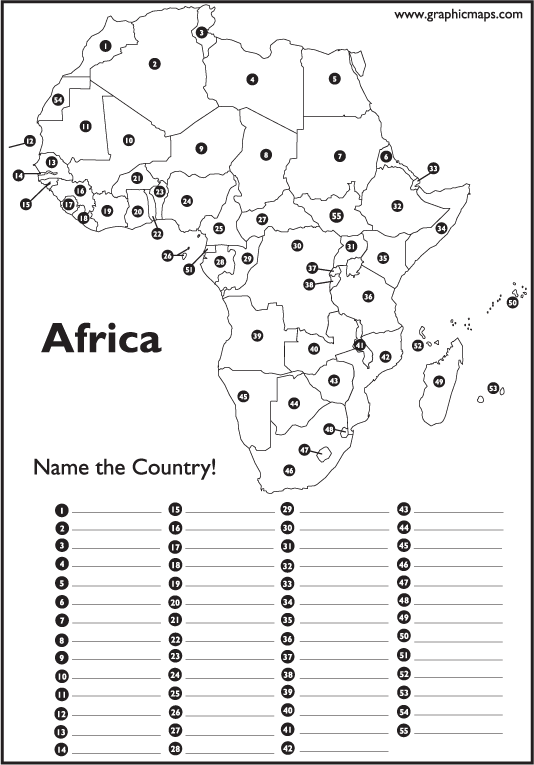
First of all, the answers to the Name the Countries of Africa test.
No doubt, more than fifty per cent success rate was achieved by anyone who took the test.

Perhaps, it should be pointed out at this stage how the boundaries of these countries were drawn in the first place; please, go to this page to read about the Berlin West Africa Conference of 1884-85 (see map below as well).


Today, the political map of Africa looks like this

"I am going to Africa to help" is an all-too familiar and common statement one hears non-Africans make.

Well, even though Africans are proud of their 'continental' African identity, they have come to accept their new [post February 1885] country identities, as well as the post-independence countries they are striving to make successes of.

Intense rivalries, especially when it comes to sports, have also emerged and been developed, based on one's post-independence country identity.

So, as we discovered regarding the size of Africa and the number of countries on the continent, it can only be respectful to all concerned if one is to be more specific as to which country of destination the intended help is going to be offered.

Thursday, 17 March 2016

Africans Don't Use Mobile Phones

Over the week-end of the 3rd and 4th of October 2009, a conference titled Critical Thinking for Development Education: Moving from Evaluation to Research, took place in NUI Galway.

Organised by the Development Education & Research Network (DERN) at NUI, Galway, one of the papers presented was by Richard Borowski and Jane Plastow from Leeds University Centre for African Studies (LUCAS).


The two researchers traced the background to the project; the summary of their findings of which is also presented as follows:

"African Voices is a project run by LUCAS that takes African postgraduate students studying any subject at the University of Leeds, trains them in relation to the British education system and to active learning methodologies and then sends them out into Leeds schools, years 5-8, to work in a range of modes to challenge negative ideas about the continent, to help make Africa 'real' to young people, and to seek to arouse their interest in different cultures.


Children's Negative Images of Africa
One of the main questions this project has caused us to debate is why children have such negative ideas about Africa. The evidence seems to be that there are two main sources of negative image making: the media and charity campaigns.

Images of Africa on Television
The images that children are exposed to in the media, and this we think would be primarily on the television, are of an Africa that is disaster ridden.

There is very little cultural or documentary material shown on British television relating to the continent; instead it appears mostly on the news and overwhelmingly then in relation to bad news stories.

When I did a trawl on the internet for this article to see what the BBC had been recently saying about the continent I quickly came to an Africa site that invited me to put in only the following keywords: civil war, elections, famine, human rights, peace negotiations, political parties and war. These are apparently for the BBC the things that primarily go on in Africa.

It is no wonder that young children see a largely undifferentiated continent of helplessness, danger and poverty: for that matter many of their parents and teachers probably see the same things. The only other image of Africa that is widely pedalled relates to the exotic.

Television Programmes
Wildlife programmes such as the BBCs Big Cat Diaries, or ITV's appalling wildlife drama, Wild at Heart, where Africans usually come with thick accents and a willingness to serve while white people nobly rescue beautiful animals, are standard fare; while occasional series and documentaries tend to feature brave and beautiful young white people going off to live - ostensibly alone (except of course for the TV crew) - with Africans of the noble savage variety - Massai and San bushmen are favourites here, demonstrating how 'aboriginal' peoples really do have cultures, but are of course usually being squeezed out of their peaceful lives by the incursions of such forces as corrupt governments, predatory farmers or foreign tourism.

The brave young white people always fall in love with these ‘aboriginals’, go through a spiritual experience, wear some weird clothes and eat something utterly disgusting before sadly saying goodbye to the accompaniment of a vibrant music track.

Given this highly selective and distorted imagery it is hardly surprising that primary school children in the UK believe that Africans don't use mobile phones, buses, computers, or iPods?

Or that they think most Africans live in mud huts whereas the latest statistics show that 38% of the continent is now urbanised, and Africa is experiencing the greatest growth in the use of mobile phones anywhere in the world.

Charity Campaigns on Television
The second source of popular information is undoubtedly charitable campaigning. Programmes such as the annual Comic Relief beano or Blue Peter appeal bombard us with pictures of cute children - often again outside mud huts, and on the major charity's websites one finds image after image of poverty and suffering.

Aid Agencies: their Presence and Campaigns in Schools
Within schools, charitable giving is often encouraged as being a good thing to promote compassion in children, but inevitably it is likely to further promote ideas of African helplessness and of the superiority of life in the West, not just in material terms, but arguably in terms of the West being better, kinder and necessary to the well-being of the world's helpless poor. At worst we would argue this is a breeding ground for racism."

"These people are so different, so useless, that we in the West just must be superior", Borowski & Plastow offered this assessment of pupils' views as a consequence of the type of information and images of Africa referred to above.

Any similarities with the situation here in Ireland?

Details of the links to the Conference Paper on 
Young People’s Perceptions of Africa can be found here.

Visit the LUCAS Schools Africa Project.

Friday, 29 January 2016

How to Help Africa?

Africa is the one continent in our world which is generally thought of as constantly in need of help from outsiders.

Going back in history (from around the 15th century), and continuing into the present day, individuals and institutions (statutory, voluntary or non-governmental), have made the spiritual, social, technical and economic responsibility of Africans their lifetime occupation.

In this instalment of writings, the objective is to start an ongoing discussion, asking searching questions about what it means when one talks about 'helping Africa'.


We might start with the size of the continent: thanks to The Times Atlas for the (entirely self-explanatory) Africa in Perspective map above.

From the most northerly point, Ras ben Sakka (37°21′ N) in Tunisia, to the most southerly point, Cape Agulhas (34°51′15″ S) in South Africa, is a distance of approximately 8,000 kilometres (5,000 miles).

From the Cap Vert Peninsula (17°33′22″ W) in Senegal, the westernmost point, to Ras Hafun (Raas Xaafuun, Cape Guardafui headland, 51°27′52″ E) in Somalia, the most easterly projection, is a distance (also approximately) of 7,400 kilometres (4,600 miles).

Image Source / Credit: https://africathistime.wordpress.com/


There are 54 recognised independent countries on the continent; forty-eight of these are located on the main landmass while the island nations are located off the coasts of West and Central Africa in the Atlantic Ocean, and off the East and Southern African coasts in the Indian Ocean.

Africa has an area of 30,368,609 square kilometres (11,725,385 square miles), including the island nations.

The largest country is Algeria, while Gambia is the smallest country on the continent's mainland.

A little exercise to test our knowledge of the continent might help to find out how many of the countries one can identify and name from the map below.

Map of Africa Exercise


Info Box

Cradle of Humankind

Lucy (Dinkenesh)
In 1974, archaeologists working at Hadar in the Awash Valley of Ethiopia's Afar Depression came across a human skeleton which they named Lucy because the Beatles song, "Lucy in the Sky with Diamonds" was playing in the background. Her real name, however, is Dinkenesh, meaning 'you are blessed'.
This discovery has led to Ethiopia being referred to as the 'Cradle of Humankind'.


Tuesday, 15 December 2015

Fellowship


The following piece by the Czech writer Franz Kafka (1883-1924) offers an interesting parable for modern Ireland to contemplate. Its theme of inclusion/exclusion has, obviously, more than one possible application. We print it in full, leaving the reader to decide which area(s) of Irish life it might currently serve to illuminate.

We are five friends, one day we came out of a house one after the other, first one came and placed himself beside the gate, then the second came, and placed himself near the first one, then came the third, then the fourth, then the fifth. Finally we all stood in a row.
People began to notice us, they pointed at us and said: Those five just came out of that house. Since then we have been living together; it would be a peaceful life if it weren’t for a sixth one continually trying to interfere. He doesn’t do us any harm, but he annoys us, and that is harm enough; why does he intrude where he is not wanted?
We don’t know him and don’t want him to join us. There was a time, of course, when the five of us did not know one another either; and it could be said that we still don’t know one another, but what is possible and can be tolerated by the five of us is not possible and cannot be tolerated with this sixth one.
In any case, we are five and don’t want to be six. And what is the point of this continual being together anyhow? It is also pointless for the five of us, but here we are together and will remain together; a new combination, however, we do not want, just because of our experiences. But how is one to make all this clear to the sixth one?
Long explanations would also amount to accepting him in our circle, so we prefer not to explain and not to accept him. No matter how he pouts his lips we push him away with our elbows, but however much we push away, back he comes.

Franz Kafka. from Description of a Struggle & Other Stories, Penguin, 1978/9.