Saturday, 15 October 2016

How to Help Africa? Which Country?

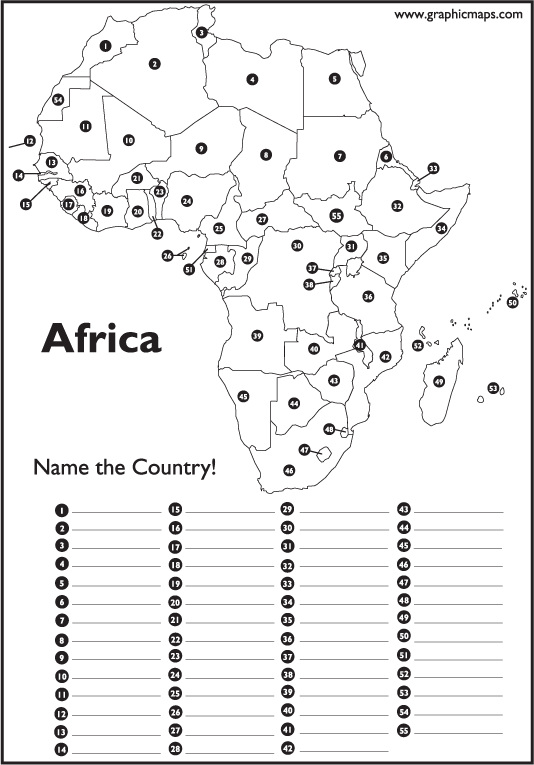
First of all, the answers to the Name the Countries of Africa test.
No doubt, more than fifty per cent success rate was achieved by anyone who took the test.

Perhaps, it should be pointed out at this stage how the boundaries of these countries were drawn in the first place; please, go to this page to read about the Berlin West Africa Conference of 1884-85 (see map below as well).


Today, the political map of Africa looks like this

"I am going to Africa to help" is an all-too familiar and common statement one hears non-Africans make.

Well, even though Africans are proud of their 'continental' African identity, they have come to accept their new [post February 1885] country identities, as well as the post-independence countries they are striving to make successes of.

Intense rivalries, especially when it comes to sports, have also emerged and been developed, based on one's post-independence country identity.

So, as we discovered regarding the size of Africa and the number of countries on the continent, it can only be respectful to all concerned if one is to be more specific as to which country of destination the intended help is going to be offered.

Thursday, 17 March 2016

Africans Don't Use Mobile Phones

Over the week-end of the 3rd and 4th of October 2009, a conference titled Critical Thinking for Development Education: Moving from Evaluation to Research, took place in NUI Galway.

Organised by the Development Education & Research Network (DERN) at NUI, Galway, one of the papers presented was by Richard Borowski and Jane Plastow from Leeds University Centre for African Studies (LUCAS).


The two researchers traced the background to the project; the summary of their findings of which is also presented as follows:

"African Voices is a project run by LUCAS that takes African postgraduate students studying any subject at the University of Leeds, trains them in relation to the British education system and to active learning methodologies and then sends them out into Leeds schools, years 5-8, to work in a range of modes to challenge negative ideas about the continent, to help make Africa 'real' to young people, and to seek to arouse their interest in different cultures.


Children's Negative Images of Africa
One of the main questions this project has caused us to debate is why children have such negative ideas about Africa. The evidence seems to be that there are two main sources of negative image making: the media and charity campaigns.

Images of Africa on Television
The images that children are exposed to in the media, and this we think would be primarily on the television, are of an Africa that is disaster ridden.

There is very little cultural or documentary material shown on British television relating to the continent; instead it appears mostly on the news and overwhelmingly then in relation to bad news stories.

When I did a trawl on the internet for this article to see what the BBC had been recently saying about the continent I quickly came to an Africa site that invited me to put in only the following keywords: civil war, elections, famine, human rights, peace negotiations, political parties and war. These are apparently for the BBC the things that primarily go on in Africa.

It is no wonder that young children see a largely undifferentiated continent of helplessness, danger and poverty: for that matter many of their parents and teachers probably see the same things. The only other image of Africa that is widely pedalled relates to the exotic.

Television Programmes
Wildlife programmes such as the BBCs Big Cat Diaries, or ITV's appalling wildlife drama, Wild at Heart, where Africans usually come with thick accents and a willingness to serve while white people nobly rescue beautiful animals, are standard fare; while occasional series and documentaries tend to feature brave and beautiful young white people going off to live - ostensibly alone (except of course for the TV crew) - with Africans of the noble savage variety - Massai and San bushmen are favourites here, demonstrating how 'aboriginal' peoples really do have cultures, but are of course usually being squeezed out of their peaceful lives by the incursions of such forces as corrupt governments, predatory farmers or foreign tourism.

The brave young white people always fall in love with these ‘aboriginals’, go through a spiritual experience, wear some weird clothes and eat something utterly disgusting before sadly saying goodbye to the accompaniment of a vibrant music track.

Given this highly selective and distorted imagery it is hardly surprising that primary school children in the UK believe that Africans don't use mobile phones, buses, computers, or iPods?

Or that they think most Africans live in mud huts whereas the latest statistics show that 38% of the continent is now urbanised, and Africa is experiencing the greatest growth in the use of mobile phones anywhere in the world.

Charity Campaigns on Television
The second source of popular information is undoubtedly charitable campaigning. Programmes such as the annual Comic Relief beano or Blue Peter appeal bombard us with pictures of cute children - often again outside mud huts, and on the major charity's websites one finds image after image of poverty and suffering.

Aid Agencies: their Presence and Campaigns in Schools
Within schools, charitable giving is often encouraged as being a good thing to promote compassion in children, but inevitably it is likely to further promote ideas of African helplessness and of the superiority of life in the West, not just in material terms, but arguably in terms of the West being better, kinder and necessary to the well-being of the world's helpless poor. At worst we would argue this is a breeding ground for racism."

"These people are so different, so useless, that we in the West just must be superior", Borowski & Plastow offered this assessment of pupils' views as a consequence of the type of information and images of Africa referred to above.

Any similarities with the situation here in Ireland?

Details of the links to the Conference Paper on 
Young People’s Perceptions of Africa can be found here.

Visit the LUCAS Schools Africa Project.

Friday, 29 January 2016

How to Help Africa?

Africa is the one continent in our world which is generally thought of as constantly in need of help from outsiders.

Going back in history (from around the 15th century), and continuing into the present day, individuals and institutions (statutory, voluntary or non-governmental), have made the spiritual, social, technical and economic responsibility of Africans their lifetime occupation.

In this instalment of writings, the objective is to start an ongoing discussion, asking searching questions about what it means when one talks about 'helping Africa'.


We might start with the size of the continent: thanks to The Times Atlas for the (entirely self-explanatory) Africa in Perspective map above.

From the most northerly point, Ras ben Sakka (37°21′ N) in Tunisia, to the most southerly point, Cape Agulhas (34°51′15″ S) in South Africa, is a distance of approximately 8,000 kilometres (5,000 miles).

From the Cap Vert Peninsula (17°33′22″ W) in Senegal, the westernmost point, to Ras Hafun (Raas Xaafuun, Cape Guardafui headland, 51°27′52″ E) in Somalia, the most easterly projection, is a distance (also approximately) of 7,400 kilometres (4,600 miles).

Image Source / Credit: https://africathistime.wordpress.com/


There are 54 recognised independent countries on the continent; forty-eight of these are located on the main landmass while the island nations are located off the coasts of West and Central Africa in the Atlantic Ocean, and off the East and Southern African coasts in the Indian Ocean.

Africa has an area of 30,368,609 square kilometres (11,725,385 square miles), including the island nations.

The largest country is Algeria, while Gambia is the smallest country on the continent's mainland.

A little exercise to test our knowledge of the continent might help to find out how many of the countries one can identify and name from the map below.

Map of Africa Exercise


Info Box

Cradle of Humankind

Lucy (Dinkenesh)
In 1974, archaeologists working at Hadar in the Awash Valley of Ethiopia's Afar Depression came across a human skeleton which they named Lucy because the Beatles song, "Lucy in the Sky with Diamonds" was playing in the background. Her real name, however, is Dinkenesh, meaning 'you are blessed'.
This discovery has led to Ethiopia being referred to as the 'Cradle of Humankind'.


Tuesday, 15 December 2015

Fellowship


The following piece by the Czech writer Franz Kafka (1883-1924) offers an interesting parable for modern Ireland to contemplate. Its theme of inclusion/exclusion has, obviously, more than one possible application. We print it in full, leaving the reader to decide which area(s) of Irish life it might currently serve to illuminate.

We are five friends, one day we came out of a house one after the other, first one came and placed himself beside the gate, then the second came, and placed himself near the first one, then came the third, then the fourth, then the fifth. Finally we all stood in a row.
People began to notice us, they pointed at us and said: Those five just came out of that house. Since then we have been living together; it would be a peaceful life if it weren’t for a sixth one continually trying to interfere. He doesn’t do us any harm, but he annoys us, and that is harm enough; why does he intrude where he is not wanted?
We don’t know him and don’t want him to join us. There was a time, of course, when the five of us did not know one another either; and it could be said that we still don’t know one another, but what is possible and can be tolerated by the five of us is not possible and cannot be tolerated with this sixth one.
In any case, we are five and don’t want to be six. And what is the point of this continual being together anyhow? It is also pointless for the five of us, but here we are together and will remain together; a new combination, however, we do not want, just because of our experiences. But how is one to make all this clear to the sixth one?
Long explanations would also amount to accepting him in our circle, so we prefer not to explain and not to accept him. No matter how he pouts his lips we push him away with our elbows, but however much we push away, back he comes.

Franz Kafka. from Description of a Struggle & Other Stories, Penguin, 1978/9.

Thursday, 26 February 2015

Berlin West Africa Conference: 130 Years Later

"IN TESTIMONY WHEREOF the several plenipotentiaries have signed the present General Act and have affixed thereto their seals.
DONE at Berlin, the 26th day of February, 1885."


So concluded a three month long conference 130 years ago today.

Below, is a summary of that Conference as it appears in the Encyclopaedia Britannica:

"Berlin West Africa Conference, a series of negotiations (Nov. 15, 1884–Feb. 26, 1885) at Berlin, in which the major European nations met to decide all questions connected with the Congo River basin in Central Africa.

The conference, proposed by Portugal in pursuance of its special claim to control of the Congo estuary, was necessitated by the jealousy and suspicion with which the great European powers viewed one another’s attempts at colonial expansion in Africa. The general act of the Conference of Berlin declared the Congo River basin to be neutral (a fact that in no way deterred the Allies from extending the war into that area in World War I); guaranteed freedom for trade and shipping for all states in the basin; forbade slave trading; and rejected Portugal’s claims to the Congo River estuary—thereby making possible the founding of the independent Congo Free State, to which Great Britain, France, and Germany had already agreed in principle."

Another useful site for further details is: Berlin Conference of 1884-1885 to Divide Africa.

The consequences of this Conference are still being felt today and the debate continues.

Sunday, 19 January 2014

An African Paradise in Ireland


National Botanic Gardens, Dublin


There is one place in Ireland where I enjoy visiting to spend some quiet and peaceful moments.

This place also happens to reflect Africa in a very particular way, and where the Story of Africa is told through its plants. It is also a place I consider to be my 'African Paradise in Ireland'.

This place is the National Botanic Gardens in Glasnevin, Dublin.

My visit would usually begin / start in the central part of the Curvilinear Range glasshouse on the eastern side of the Garden where, perhaps the, arguably, most important plant to have made its way into human social life, can be found. I am, of course, referring to the coffee plant.

The Coffee Plant in the National Botanic Gardens, Dublin

Next to the coffee plant is another plant associated with a hot beverage, the tea plant. There are a few other plants, including the avocado, in the Curvilinear Range glasshouse which I associate with growing up in West Africa; I hope to say a bit more about these plants in subsequent instalments of my African Plant Tales from the Botanic Gardens.

The next stop during my visit is the Great Palm House. This is also the place where I experience a real tropical feeling - in the air I breathe and the feeling of the moisture on my skin.

As the name suggests, the palm tree is one of the main plants to be seen here: the oil palm and the coconut palm. Another coffee plant can be seen here.

Green and Red Berries on a Coffee Plant

One significant plant in the Great Palm House is the bamboo; a plant which also deserves a whole story to itself to be narrated at a later date. For the moment, let us just remark that the bamboo belongs to the grass family. A mention of the banana would be made before leaving the Great Palm House.

On one adjoining side of the Great Palm House is the Cactus and Succulent glasshouse. Here, one would see plants such as varieties of the cactus family which I would have come in contact with in parts of West Africa.

The National Botanic Gardens' Information on Coffee

My visit would be rounded off with some moments for reflection in the café which is located in the Visitor Centre, and where the friendly staff are always on hand to serve me, well, coffee; no doubt, perhaps Coffea Arabica from Ethiopia?

Indeed, after a visit to the National Botanic Gardens, and a homage to the coffee plant, one would look at the next cup of coffee in a completely new light, and even consider the taste of that cup of coffee as a totally new experience.


National Botanic Gardens
Glasnevin
Dublin 9
Ireland.
Telephone No: + 353 1 804 03 19 / 857 09 09 (Visitor Centre)
Fax No: + 353 1 836 00 80
Website http://www.botanicgardens.ie

Monday, 7 October 2013

Remembering The Late Justice Annie Jiagge

Today is the 95th anniversary of the birth of the Late Justice Mrs Annie Ruth Jiagge, the first woman in Ghana - and indeed, in the (British) Commonwealth - to be appointed a High Court judge.

In October 2008, an event to commemorate the 90th anniversary of her birth was held in Dublin. Below, we reproduce the piece written to mark that occasion.

The Late Justice Annie Ruth Jiagge

Celebrating the Life and Memory of a Remarkable African Woman

She was well-known to former President Mary Robinson but the name Justice Annie Ruth Jiagge might not mean anything or much to people in Ireland; perhaps not even those involved in the Women’s Movement.
Yet, the late Justice Annie Jiagge, Ghana’s first woman High Court judge, was instrumental in the UN’s first document on Women’s Rights, the Draft Declaration on the Convention on the Elimination of All Forms of Discrimination Against Women, also referred to as CEDAW, which she co-authored and which was first adopted on 7 November, 1967, by the General Assembly.
Image Source: World Council of Churches

Born on the 7th of October, 1918, the late Justice Annie Ruth Jiagge (née Baeta) entered the legal profession after a career in education. She was appointed to the High Court on the 15th of September, 1961. Indeed, she was the first ever woman High Court judge appointed in the (British) Commonwealth.
Justice Annie Jiagge’s legal career progressed with her appointment to the Court of Appeal in 1969, becoming its president in 1980, a position she held until her retirement in 1983.

On the international scene, Justice Jiagge served on the UN’s Commission on the Status of Women (CSW) and chairing it in 1968. She was a member of Dr Boutros-Boutros Ghali’s advisory group appointed to plan the Fourth World Conference on Women.

She was a member of the World Council of Churches (WCC), which she served for over 44 years, becoming the first African woman President when she was elected by the 5th assembly at Nairobi in 1975. She was elected Moderator (Chair) of its Commission on the Programme to Combat Racism. Justice Jiagge was instrumental in shaping the WCC’s tough attitude against the injustice of apartheid in South Africa.

Justice Annie Jiagge was a founding member of the Women’s World Banking, an organisation aimed at granting women access to credit and which her fellow Ghanaian, the late Dr Esther Ocloo, was the first chair.

While a student in London, Annie Baeta had participated in the activities of the Young Women’s Christian Association (YWCA). She was made a Member of the Executive Committee of the World YWCA soon after joining it, and eventually Vice-President. In her own country in Ghana, she found time outside her legal career and was instrumental in founding the National Women’s Council and the YWCA.

Annie Jiagge also kept her interest in education. She served on the Council of the University of Ghana at Legon for twelve years and was a member of the Administrative and Management Committee of the Ghana Academy of Sciences.

The late Justice Annie Jiagge was only one of the many African women who have made their contributions in their own countries, as well as in the international domain.

Dr. Asha-Rose Migiro, who was appointed Deputy Secretary-General of the United Nations in January, 2006, is the first woman Minister for Foreign Affairs and International Co-operation of the Republic of Tanzania.

Judge Akua Kuenyehia from Ghana is currently the First Vice-President, International Criminal Court in The Hague, while Former Nigerian Finance Minister Ngozi Okonjo-Iweala, who was in Ireland earlier this year [2008], is now the Managing Director of the World Bank.

As we mark the 30th anniversary next year [2009] of the final adoption of CEDAW at the 34th Session of the General Assembly, perhaps highlighting the achievements and strengths of African women on the 90th anniversary of the late Justice Annie Jiagge’s birth would be appropriate?

It is also important that we continue to identify, acknowledge and celebrate other African women achievers by bringing their stories to the rest of the world.

Justice Mrs Annie Ruth Jiagge died on the 12th of June, 1996.


Friday, 3 May 2013

Remembering Chinua Achebe

One of Nigeria and Africa's major writers, Chinua Achebe, passed away on the 21st of March in Boston in the US.

Amy's story

Achebe's best-known novel, Things Fall Apart, claims two Irish connections: the title itself was from William Butler Yeats' poem, The Second Coming, while the motivation for the writing came from a response

Joyce Cary and Mister Johnson.

My own personal Chinua Achebe memory first happened when Things Fall Apart was one of the texts on

Wednesday, 27 February 2013

Earliest African Presence in Ireland

The name David Ben-Anna, or ‘Lampo’, might not be familiar to many people in Ireland. We will come back to ‘Lampo’ Ben-Anna and his place in Irish history a little while later.

“You must be the first ‘black’ person in Ireland”, people would often say to this person I know when they are told of the date of his first arrival in Ireland in the early 1980s. 

Disappointingly, however, much as this person would have liked to claim this 'honour', this was not to be the case.

Indeed, over the last decade or two, people of African origin have become more noticeable in Ireland, but to think or presume that the 1980s was when they first arrived in this country would be very far from the reality.

So, my friend having missed out on the distinction of being the first ‘black’ person in Ireland, who then holds this? Well, let’s get back to ‘Lampo’.

I am indebted to Dr. William A. Hart, formerly of the University of Ulster at Coleraine, and who has been researching the history of people of African heritage in Ireland.

Ireland's links with Africa, in terms of the African presence in Ireland, also go back to a period which would surprise many people.

According to Dr. Hart, the earliest definite reference to a named person of African heritage (or ‘black’ / dark-skinned person) was in the Parish Register of St Mary’s Parish, Youghal, Co Cork.

This register was compiled by the Editor of St Mary's Parish Magazine, the Reverend C. Stewart, who was also thanked for the “very interesting” and early notices of christenings, marriages and burials:

“Christenings 1666: April 08 - David Ben-Anna (formerly Lampo) a negro, aged 15 years or thereabouts, born in Mountserat, one of ye Cariby Islands in Mere Del Noova in ye coast of America”.

At about the same time of Lampo’s christening with the new name of David Ben-Anna in the 1660s, Elizabeth, Duchess of Ormonde [1615–1684], was reported as having a 'black' page by the name of Scipio.

Thirty years before Scipio, however, there was Francisco. According to Dr Hart, a petition was made in the 1630s in the name of a 'black' slave called Francisco, who said he had formerly (in the 1620s, perhaps?) been ‘owned' by one ‘the Calvinist Jacob’ in Dublin.

Almost two hundred years later after Francisco, Scipio and 'Lampo' Ben-Anna, the following report appeared in the records of The Journal Of The Kilkenny And South-East Of Ireland Archaeological Society. VOL. II. NEW SERIES. 1858-59:

"About thirty-nine years ago a coloured man, a negro by birth, lived as servant with the Reverend William Fitzgerald, parish priest of Carlow town. This black man dreamed that a copper pan of gold was buried in the ruins of a monastery in Oakpark, the demesne of the late Colonel Bruen; he told the reverend Father, who endeavoured to dissuade him from his purpose of seeking the treasure; his arguments were in vain, so deep were the impressive hopes of success on the man's mind imprinted. He prepared; took some trusty friends by night, and dug for the treasure: after some hours' labour they came to the flag that covered the pan, on which a furious whirling wind came and extinguished their lights: they re-lighted them, on which a company of horse soldiers came galloping up and presented their arms; the gold-seekers stood horror-stricken; but the dreamer, as brave as man could be, continued to labour on while flames issued from the pit. The party fled, leaving the blackamoor man, more daring than a lion, to withstand the horrors of the whole contexture of thrilling objects in the silence and darkness of the midnight hour. He reflected, and, while reflecting, a whirlwind raged around him, and he heard a sepulchral-like voice 'A life is to be lost is that life yours?' He paused for a moment, and mentally said, “What will the treasure avail me if I am dead?’’ On which he left the place. The next day he visited the scene of terror, and, much to his surprise, he could not find the exact spot; no marks of the night's labour remained.” pages 108-109

Mention should also be made here of Frederick Douglass, a Black American, who arrived in Ireland in August 1845. He was reported as having stayed in Ireland and Britain for about two years, during which time Douglass was also reputed as having met and befriended the 'Liberator' himself, Daniel O’Connell.

Francisco’s experience with ‘the Calvinist Jacob’ might not exactly have been a pleasant one, him having been his slave, but we might take a look at this sad and tragic story, which took place eighty-eight years before David ‘Lampo’ Ben-Anna’s christening. 

The following was recorded as having taken place in Kilkenny in 1578:
In the November of that year, sessions were held there by the Lord Justice Drury and Sir Henry Fitton, who, in their letter to the Privy Council on the 20th of the same month, inform that Body that upon arriving at the town "the jail being full we caused sessions immediately to be held. Thirty-six persons were executed, amongst whom were some good ones, a blackamoor and two witches by natural law, for that we find no law to try them by in this realm." It is easy to see why the witches were put to death, but the reason for the negro's execution is not so obvious. It can hardly have been for the colour of his skin, although no doubt a black man was as much a rara avis in the town of Kilkenny as a black swan. Had the words been written at the time the unfortunate negro might well have exclaimed, though in vain, to his judges:
"Mislike me not for my complexion--
The shadowed livery of the burning sun."

Or could it have been that he was the unhappy victim of a false etymology! For in old writers the word "necromancy" is spelt "nigromancy," as if divination was practised through the medium of negroes instead of dead persons; indeed in an old vocabulary of 1475 "Nigromantia" is defined as "divinatio facta per nigros." He may therefore have been suspected of complicity with the two witches. pages 60-61

Source: Irish Witchcraft And Demonology By St John D. Seymour, B.D. Baltimore: Norman, Remington [1913]

So, first we have this poor unfortunate, and unnamed, fellow who was executed in Kilkenny in 1578 for a reason which is “not so obvious”.

Then there was Francisco petitioning for his freedom from slavery in the 1630s, on to the newly christened David ‘Lampo’ Ben-Anna (1666) and Scipio the page in the mid 1600s.

Finally, there was yet another unnamed 'black' man, a servant of the Reverend William Fitzgerald, parish priest of Carlow Town in the 19th century.

These were some of the documented cases, so far known, of the presence of people of African origin in Ireland between the 16th and 19th centuries.

It is also rather noticeable that none of these was female, nor has a female person been identified so far.

A little bit of background history too on the African / ‘black’ presence in Ireland, and a long way from the 16th century to the present day.

Fortunately, unlike our Kilkenny ‘blackamoor’ and Francisco, ‘the Calvinist Jacob’s’ 'slave', Africans in today’s Ireland don’t have to face executions or petition for freedom from slavery.

Still, they face other equally difficult challenges.